Millet Glycemic Index Chart: All Millets Compared

Sources: NIN Hyderabad, ICMR, USDA FoodData Central
The glycemic index (GI) ranks carbohydrate foods by how quickly and how much they raise blood glucose compared with a reference food, on a scale of 0–100. Foods are usually grouped as Low (55 or under), Medium (56–69) and High (70 and above) (Atkinson et al., Diabetes Care 2008). This page is the reference chart we link to from our other millet guides.
Managing PCOS? Because insulin resistance is common, low-GI grains matter — see millets for PCOS.
Glycemic index vs glycemic load — why portion matters
The glycemic index rates a fixed 50 g of available carbohydrate from a food. But you rarely eat exactly that much, so the glycemic load (GL) is often more useful in practice. GL combines a food’s GI with how much carbohydrate is actually on your plate:
Glycemic load = (GI × grams of carbohydrate per serving) ÷ 100. A GL of 10 or under is low, 11–19 is medium, and 20+ is high (Atkinson et al., Diabetes Care 2008).
This is why a modest bowl of a lower-GI millet raises blood sugar far less than a large portion of a high-GI grain — both the GI and the amount count. It is also why portion size (see below) matters as much as which grain you pick.
Shop the millets in this article
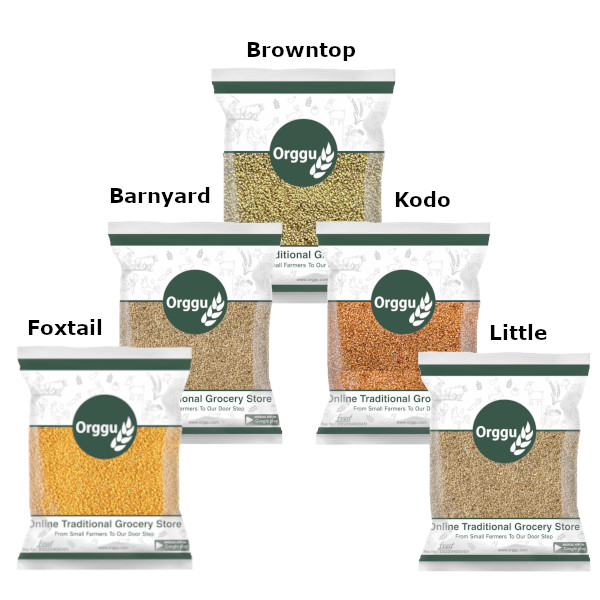
Millet glycemic index chart
The table below groups common grains by GI band. Millets generally fall in the low-to-medium range, while white rice is typically high. Because GI varies with variety, degree of polishing, and how a grain is cooked, we show bands rather than a single "exact" number for each millet — treat these as indicative, not precise.
| Grain | Typical GI band | Notes |
|---|---|---|
| Barnyard millet | Low | Often cited around GI ~41 in Indian studies — among the lowest of the millets. |
| Foxtail millet | Low–Medium | Popular rice substitute; keep it unpolished. |
| Little millet | Low–Medium | Mild flavour, cooks like rice. |
| Kodo millet | Low–Medium | High in fibre. |
| Browntop millet | Low–Medium | Rarest Siridhanya millet. |
| Finger millet (ragi) | Medium | GI rises when finely ground and made into soft dough/porridge. |
| Pearl millet (bajra) | Medium | Whole/cracked forms are lower than fine flour. |
| Sorghum (jowar) | Medium | Whole grain is lower than refined flour. |
| White rice | High | Commonly ~70+; a benchmark high-GI staple. |
| Whole wheat | Medium–High | Depends heavily on how finely it is milled. |
GI bands are drawn from published GI tables and Indian nutrition literature (see sources). Exact GI values for individual millet varieties vary between studies; where a specific number is well established (e.g. barnyard ~41) we have noted it, otherwise we use bands.
What changes a millet’s GI
- Polishing: unpolished millets keep their fibre-rich bran, which slows sugar absorption. Choose unpolished millets where possible.
- Grinding: whole or cracked grain generally has a lower GI than very fine flour.
- Cooking & cooling: overcooking into a soft paste tends to raise GI; some resistant starch forms on cooling.
- What you eat it with: pairing with vegetables, dal, curd or healthy fat lowers the overall glycemic response of the meal.
Millets and blood-sugar-conscious eating
Because most millets are lower-GI and high in fibre, they are often chosen as part of a balanced, blood-sugar-conscious diet in place of white rice. Millets are a food, not a treatment — they do not cure or reverse any condition. If you are managing diabetes, read our detailed guide to the best millets for diabetes and shop the millets for diabetes range, and always follow your doctor’s advice on diet and medication.
Millets vs rice, wheat, oats & quinoa
Set against the staples they usually replace, millets as a group sit in the low-to-medium band while white rice sits high. The reference values below come from published international GI tables; they vary by variety and cooking, so treat them as indicative rather than exact.
| Food | Typical GI | Band |
|---|---|---|
| Most millets (unpolished) | ~40–60 | Low–Medium |
| Quinoa | ~53 | Low–Medium |
| Rolled oats (porridge) | ~55 | Medium |
| Whole wheat roti / bread | ~62–72 | Medium–High |
| White rice (boiled) | ~73 | High |
Reference GI values for quinoa (~53), oats (~55), whole wheat and white rice (~73) are from the International Tables of Glycemic Index (Atkinson et al., 2008); actual figures vary with variety and preparation.
The practical takeaway: swapping white rice for an unpolished millet, in a sensible portion, is one of the simpler ways to lower a meal’s glycemic load — one reason millets are popular in blood-sugar-conscious diets. Browse unpolished millets online.
Millet-by-millet GI profiles
All figures below are indicative; GI varies with variety, polishing and cooking. Values are shown as bands except where a specific figure is well established.
- Barnyard (Oodalu / Kuthiraivali): often cited around GI ~41 — among the lowest of the millets and very high in fibre; a common first choice for low-GI meals.
- Kodo (Harka / Varagu): low–medium band, high in fibre and filling.
- Little (Saame / Samai): low–medium; cooks closest to rice, making it an easy first swap.
- Foxtail (Navane / Korralu): low–medium; the most popular everyday rice substitute.
- Browntop (Korale / Andu Korralu): low–medium; the rarest Siridhanya millet, fibre-rich.
- Finger (Ragi / Nachni): medium, and it climbs when finely ground into soft dough or malt — eat as whole grain or coarse flour where you can. Notable for calcium (NIN, IFCT 2017).
- Pearl (Bajra): medium; whole or cracked forms are lower than fine flour.
- Sorghum (Jowar): medium; whole grain is lower than refined flour.
New to cooking these? See how to cook millets perfectly, or read the detailed guide to the best millets for diabetes.
Cooking, cooling & polishing — how to keep a millet’s GI low
Polishing strips the fibre-rich bran, so polished millets are digested faster than unpolished ones — a good reason to choose whole, unpolished grain. Overcooking a millet into a soft paste raises its GI, while whole or coarsely cooked grain digests more slowly. Cooking and then cooling cooked grains lets some starch reform as resistant starch, which the body digests more slowly (a well-documented effect for cooked-and-cooled starchy foods). Finally, what you pair it with — fibre, protein, curd or a little healthy fat — slows the whole meal’s glucose response. Sources: NIN Indian Food Composition Tables (2017); Atkinson et al., Diabetes Care 2008.
Practical portion guidance
Because glycemic load depends on quantity, portion size matters. A typical single serving is about 50–75 g of dry millet (roughly a cupped handful) once cooked. Building the plate around vegetables, dal or curd with a moderate millet portion keeps a meal’s overall glycemic load lower than a large bowl of any grain alone. This is general information, not a prescription — anyone managing blood sugar should personalise portions with their doctor or dietitian and their own glucose readings.
Sources & References
- Atkinson FS, Foster-Powell K, Brand-Miller JC. International Tables of Glycemic Index and Glycemic Load Values. Diabetes Care 2008;31(12):2281–2283
- Indian Food Composition Tables (2017) — National Institute of Nutrition (NIN), Hyderabad / ICMR
- USDA FoodData Central — U.S. Department of Agriculture