Orggu
From Small Farmers
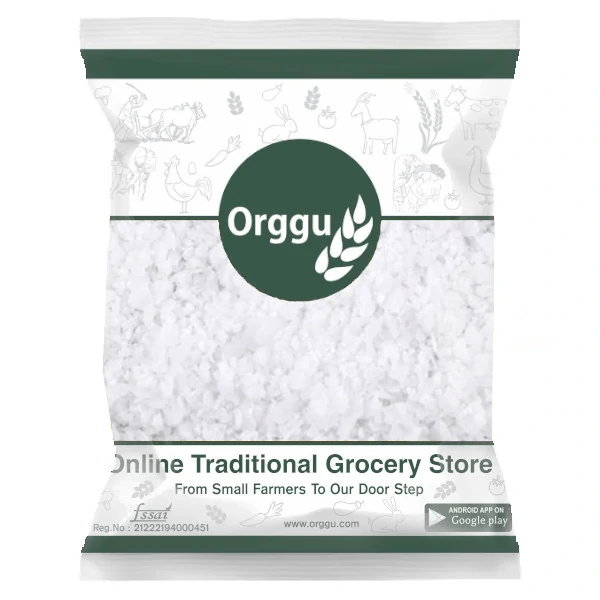
Non-iodized salt is salt with no iodine added. Ours is sea salt from the Thoothukudi salt pans, sun-dried and washed, with nothing added: crystals from ₹30 or powder from ₹30.
Iodized salt has a small amount of iodine added, usually as potassium iodate, to prevent iodine deficiency. Non-iodized salt is simply salt without it. Sea salt can be iodized or not, so “sea salt” on a pack does not tell you on its own; ours is not iodized, and nothing else is added either.
Many iodized table salts also contain an anti-caking or free-flow agent so the salt pours in damp weather. Ours has none, which is why it can clump when the air is humid.
| Iodized salt | Our non-iodized sea salt | |
|---|---|---|
| Iodine | Added (usually potassium iodate) | None added |
| Anti-caking agent | Often added | None |
| Sodium | About 38.7 g per 100 g | Salt is almost all sodium chloride, so about the same |
| Recommended for | Most households in India | Specific uses, such as pickling, or when a doctor advises it |
Whichever you use, the salt type does not change how much sodium you eat; only the amount does.
| Per 100 g | Salt, table (FDC 173468) | Salt, table, iodized (FDC 746775) |
|---|---|---|
| Sodium | 38,758 mg | 38,700 mg |
| Iodine | not listed | 5,080 µg |
| Energy | 0 kcal | — |
Source: USDA FoodData Central, Salt, table and Salt, table, iodized. Reference values for salt in general, not a lab test of our packs.
Our sea salt comes from the salt pans of Thoothukudi (Tuticorin) on the Tamil Nadu coast. It is sun-dried in the pans and washed; the powder is ground from the same crystals. Nothing is added. More on the pans and the two forms is on our sea salt page.
| Crystals | Powder | |
|---|---|---|
| Texture | Coarse | Fine |
| Best for | Pickling, brining, salting before drying | Pickle masalas, quick brines |
| Packs and price | 500 g — ₹30 1 kg — ₹50 | 500 g — ₹30 1 kg — ₹50 |
| Lowest price per kg | ₹50 per kg | ₹50 per kg |
In Hindi it is usually called bina iodine wala namak (salt without iodine); salt is namak in Hindi and uppu in Tamil, Telugu, Kannada and Malayalam. Rock salt, sendha namak, is a different salt, sold on our Himalayan pink salt page.
The ingredients list tells you what you are buying. Iodized salt lists an iodine compound, usually potassium iodate. An anti-caking or free-flow agent appears by name or by its INS number — for example INS 551 (silicon dioxide), INS 535 or 536 (sodium or potassium ferrocyanide) or INS 554 (sodium aluminosilicate). Our sea salt lists only sea salt.
Many pickle and brine recipes ask for plain, non-iodized salt without anti-caking agents. Cooks say added agents can cloud the brine and that iodine can darken some pickles; plain coarse salt also dissolves slowly into the oil and juices, which suits pickles that mature over weeks. If you only have iodized salt, your pickle will still keep; the difference is mostly in look and texture.
Salt without an anti-caking agent stays easiest to use when it is used up quickly, so if your kitchen is humid the 500 g pack may suit you better than 1 kg. Keep the unopened pack sealed and refill a small jar from it as you need.
If you are pregnant or breastfeeding, cooking for young children, or have a thyroid condition, ask your doctor which salt to use before relying on non-iodized salt. The same applies if your doctor has told you to limit or increase iodine for any reason.
Because nothing is added to keep it free-flowing, store the salt in a dry, airtight container and use a dry spoon. Lumps break up easily.
Free delivery in Bangalore · Ships across India in 2–10 business days (charges at checkout). Cash on delivery in Bangalore; prepaid elsewhere in India.
Salt with no iodine added. Ours is sea salt from the Thoothukudi salt pans, sun-dried and washed, with nothing added.
Iodized salt is recommended for most households in India to prevent iodine deficiency. Non-iodized salt suits specific uses, such as pickling, or people whose doctor advises it.
Not always: sea salt can be iodized or not. Ours is not iodized and has nothing else added.
No. All common salts are mostly sodium chloride, so the type does not change your sodium intake; only the amount does.
Yes — our sea salt crystals and powder have no anti-caking or free-flow agent, so they may clump in humid weather.
Bina iodine wala namak — salt without iodine.
At today’s prices our sea salt crystals work out to ₹50 per kg and the powder to ₹50 per kg, in 500 g and 1 kg packs.
India’s rule that common salt must be iodized does not apply to traditional salts such as rock salt (FSSAI clarification, July 2019), so rock salt is often sold without iodine — check the pack. See our Himalayan pink salt page for ours.
Free delivery in Bangalore · Ships across India in 2–10 business days (charges at checkout)
See crystals and powder