Non-Iodized Sea Salt vs Table Salt: Which Is Healthier?

Certified organic food specialists · Sources: NIN Hyderabad, ICMR, USDA FoodData Central
📖 8 min read · In this article:
Rethinking your pantry? See jaggery vs sugar — the same honest look at a "natural" swap that is still, in the end, sugar.
- Why Most Indian Families Use the Wrong Salt
- What Is Non-Iodized Salt & Why It Matters
- Table Salt Additives: What You’re Really Eating
- Sea Salt vs Rock Salt vs Table Salt — Mineral Comparison
- Who Should Use Non-Iodized Salt
- How to Switch to Non-Iodized Salt
- Buy Natural Salt
- Frequently Asked Questions
Why Most Indian Families Use the Wrong Salt
Pick up the salt packet in your kitchen right now. Chances are it says “Iodized Salt” with a list of ingredients you’ve never questioned: sodium chloride, potassium iodate, sodium ferrocyanide, sodium aluminosilicate. That last one contains aluminium — a metal that has no business being in your food.
For decades, the Indian government promoted iodized table salt to combat iodine deficiency disorders in remote, inland regions. That campaign was necessary — and it worked. But today, most urban and semi-urban Indians get adequate iodine from dairy, eggs, seafood, and vegetables. Meanwhile, the heavily refined, chemically treated salt that was a public health tool has become the default in every Indian kitchen, and nobody questions what else is in it.
The truth is simple: table salt is a factory product. It starts as natural salt, then goes through bleaching, chemical washing, high-temperature processing, and fortification with synthetic iodine — after which anti-caking agents are added so it flows freely from the shaker. By the end, you’re left with pure sodium chloride and chemicals. Every trace mineral that natural salt originally contained — magnesium, potassium, calcium, iron, zinc — has been stripped away.
What Is Non-Iodized Salt & Why It Matters
Non-iodized salt is salt that has not been fortified with synthetic potassium iodate. This includes natural sea salt (evaporated from seawater), Himalayan rock salt (mined from ancient salt deposits), and traditional sendha namak used in Indian fasting foods. These salts are minimally processed — they retain their original mineral content without any chemical additives.
The key difference isn’t just the absence of iodine. It’s what hasn’t been removed. When salt is refined into the white, free-flowing powder you see in iodized packets, the refining process strips out magnesium, potassium, calcium, sulphur, iron, zinc, and dozens of other trace minerals. These aren’t impurities — they’re essential micronutrients that your body needs for nerve function, muscle contraction, hydration, and bone health.
Natural sea salt, by contrast, retains all of these minerals in the proportions that seawater naturally provides. This is why natural salt has a slightly grey, pink, or off-white colour — the colour comes from minerals, not contamination. Perfectly white salt is a red flag, not a quality signal — it means the salt has been bleached or chemically washed.
Table Salt Additives: What You’re Really Eating
Read the fine print on any iodized salt packet in India. Here’s what you’ll typically find:
| Additive | Purpose | Concern |
|---|---|---|
| Potassium Iodate (KIO₃) | Iodine fortification | Unnecessary for most urban diets with adequate dairy/egg intake |
| Sodium Aluminosilicate (E554) | Anti-caking agent | Contains aluminium — linked to neurotoxicity in animal studies |
| Sodium Ferrocyanide (E535) | Anti-caking agent | Cyanide compound — FSSAI-permitted at 10 mg/kg but controversial |
| Bleaching agents | Makes salt white | Strips natural mineral colour — purely cosmetic |
| Dextrose (sugar) | Stabilises iodine | Added sugar in salt — small amount but unnecessary |
Salt without anti-caking agents will clump slightly in humid weather — and that’s perfectly normal. It means nothing has been added to prevent natural moisture absorption. A quick shake or a few rice grains in the container solves clumping entirely. The question is: would you rather have salt that flows freely because of aluminium compounds, or salt that clumps slightly but contains zero chemicals?
Sea Salt vs Rock Salt vs Table Salt — Mineral Comparison
Here’s a side-by-side comparison of the three main salt types available in India. The difference in mineral content is dramatic:
| Property | Refined Table Salt | Sea Salt (Non-Iodized) | Himalayan Rock Salt |
|---|---|---|---|
| Sodium Chloride | 99.5%+ | 95–98% | 95–98% |
| Magnesium | Stripped | 0.05–0.1% | 0.01–0.03% |
| Potassium | Stripped | 0.08% | 0.03% |
| Calcium | Stripped | 0.03% | 0.04% |
| Iron | Stripped | Trace | 0.004% (pink colour) |
| Trace Minerals | 0 | 80+ (Zn, Se, Cu, Mn) | 84 (including sulphur) |
| Anti-Caking Agents | Yes (E554/E535) | None | None |
| Bleaching | Yes | No — natural grey/off-white | No — natural pink |
| Processing | Heavy (chemical wash, kiln-dried, fortified) | Minimal (sun-dried) | Minimal (mined, crushed) |
The numbers tell the story. Refined table salt is 99.5% sodium chloride — essentially a chemical compound with zero nutritional diversity. Natural sea salt and rock salt are 95–98% sodium chloride, with the remaining 2–5% comprising essential trace minerals that support everything from nerve function (magnesium) to blood pressure regulation (potassium) to bone health (calcium).
Yes, the mineral amounts are small per serving. But you eat salt with every single meal, every single day. Over a lifetime, those trace minerals add up — and their absence adds up too.
📲 Share this on WhatsAppWho Should Use Non-Iodized Salt
Non-iodized natural salt is suitable for most Indian adults with a varied diet. Here’s a practical breakdown:
Switch to non-iodized salt if you:
- Consume dairy products (milk, curd, paneer) regularly — a single cup of milk provides ~56 mcg of iodine, about 37% of the daily requirement
- Eat eggs (24 mcg iodine per egg), fish, or seafood
- Follow the Dr Khadar Vali Siridhanya diet — he specifically recommends unrefined salt
- Want to eliminate anti-caking agents (aluminium compounds) from your diet
- Are concerned about excess iodine — over-iodisation can aggravate Hashimoto’s thyroiditis and autoimmune thyroid conditions
- Use salt for traditional preservation (pickling, fermentation) — anti-caking agents interfere with fermentation cultures
Continue with iodized salt if you:
- Live in a remote, iodine-deficient region (parts of the Himalayan belt, Northeast India)
- Have a very restricted diet with no dairy, eggs, or seafood
- Are pregnant or breastfeeding and your doctor specifically recommends iodine supplementation
- Have been diagnosed with iodine deficiency by a medical professional
How to Switch to Non-Iodized Salt
Switching is straightforward. There’s no transition period or adjustment needed:
- Use sea salt for everyday cooking — it dissolves well, has a clean mineral taste, and works in every Indian dish from sambar to biryani.
- Use Himalayan rock salt for specific dishes — chaats, raita, fruit salads, lemon water, and any dish where you want a milder, slightly sweet-mineral flavour.
- For pickling and fermentation, natural salt is actually better than iodized salt. Anti-caking agents and iodine can inhibit the lactobacillus cultures needed for proper fermentation.
- Store in an airtight container with a few grains of rice to prevent clumping. Natural salt absorbs moisture — this is normal and not a quality issue.
- Use the same quantity as you would with table salt. Natural salt is slightly coarser, so you may need a marginally larger pinch, but the sodium content per gram is actually lower (95–98% vs 99.5% NaCl) — a small health bonus.
Buy Natural Salt — No Chemicals, No Anti-Caking Agents
Orggu offers two types of natural, non-iodized salt — both unrefined, additive-free, and sourced traditionally:
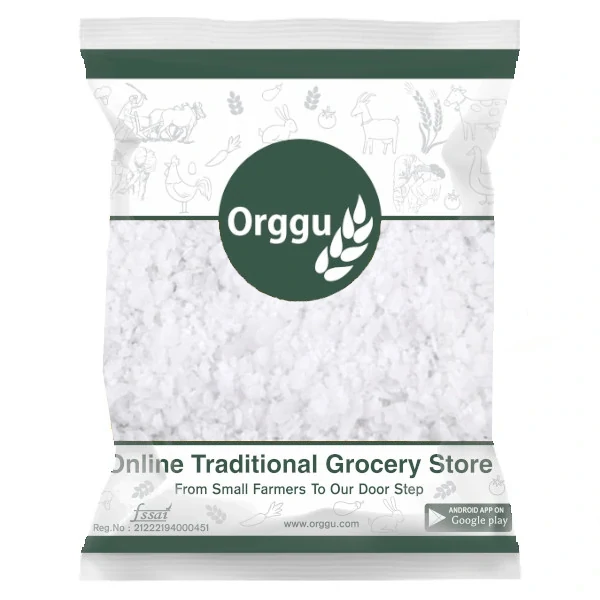
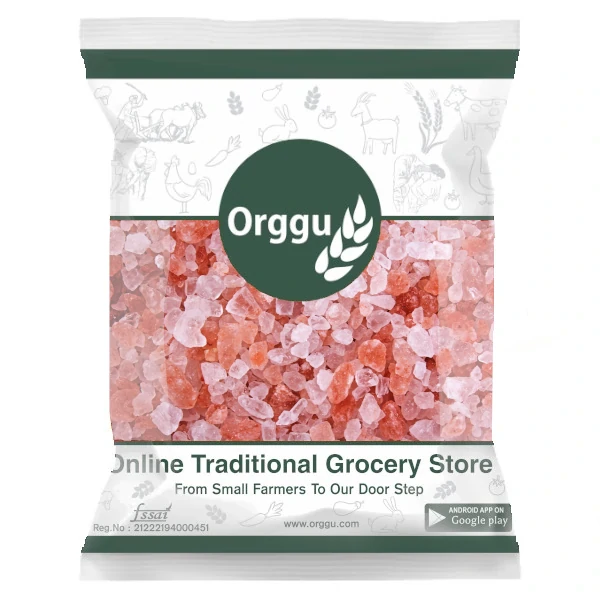
Free delivery across Bangalore. Both salts are 100% unrefined with no anti-caking agents, no bleaching, and no synthetic additives.
🌱 Why Choose Orggu Salt?
🌊 Sun-Dried Sea Salt (traditional evaporation, no kiln-drying) → 🧹 Zero Additives (no anti-caking agents, no bleaching) → ⚙️ Unrefined (80+ trace minerals retained) → 📦 Airtight Packed (food-grade packaging) → 🚚 Free Delivery (Bangalore)
Non-Iodized Salt, Sodium & Iodine — an Honest Note
Two things people often get wrong when switching salt — worth being clear and honest about.
1. Salt type does not lower your sodium. Non-iodized salt, sea salt and rock salt are all still mostly sodium chloride. Switching type does not reduce the sodium you eat — only using less salt does. So if your goal is blood pressure, the lever is quantity, not the label (see millets for blood pressure, which explains why salt reduction — not grain or salt choice — is the biggest dietary factor).
2. Do not lose sight of iodine. Iodized salt exists for a reason: it prevents iodine deficiency, which is a real public-health concern in India. If you choose non-iodized salt, make sure you get iodine from other foods — dairy, eggs, fish and other iodine-rich foods — and if you are pregnant or managing a thyroid condition, talk to your doctor before relying only on non-iodized salt.
Does non-iodized salt have less sodium than table salt?
No. All common salts — table, sea, rock and non-iodized — are mostly sodium chloride, so the type does not change how much sodium you get. Only using less salt reduces your sodium intake, which is what matters for blood pressure.
Will I get enough iodine if I use non-iodized salt?
Iodized salt is added to prevent iodine deficiency, so if you switch to non-iodized salt, make sure you get iodine from other foods such as dairy, eggs and fish. If you are pregnant or managing a thyroid condition, check with your doctor first.
Frequently Asked Questions
Also read: Polished vs Unpolished Millets: Why It Changes Everything | Refined vs Cold Pressed Oil: What’s Actually Different? | Dr Khadar Vali Millet Diet: Complete Guide
Sources & References
- Indian Food Composition Tables (2017) — National Institute of Nutrition, Hyderabad
- USDA FoodData Central — U.S. Department of Agriculture
- Indian Journal of Medical Research — Glycemic Index Studies
Switch to natural, additive-free salt
Non-Iodized Sea Salt · Himalayan Rock Salt
Zero anti-caking agents, zero bleaching. Free delivery in Bangalore.